
Our Research
We work at the interface of chemistry and physics. Our goal is to find, make, and understand quantum materials: compounds whose electrons behave in ways that textbook solid-state physics cannot describe. Theorists propose new quantum phases faster than anyone can realize them, and the bottleneck is almost always the same. Someone has to make the material. We believe that the language of chemistry (bonds, orbitals, and electron counting) is the most efficient route from an abstract theoretical proposal to a real crystal. The crystals we grow are studied in our own lab and with collaborators at Princeton and around the world.
Chemical Design Principles for Quantum Materials
Flat electronic bands, kagome physics, and magnetic topological insulators are usually discussed in the abstract language of lattice models. Real materials are messier: whether a pyrochlore compound actually shows its promised flat bands, or whether a kagome metal keeps the symmetry its physics requires, is decided by chemistry. We translate these questions into bonds, orbitals, and electron counts, and turn the answers into design rules that point to specific, synthesizable compounds.
This program began with the square net: a tolerance factor built from bond delocalization and electron count identified hundreds of topological semimetal candidates without a single band structure calculation. The same style of reasoning now covers kagome and pyrochlore lattices, and it keeps revealing that the “spectator” atoms conventional models ignore are often the decisive ingredient. Oxygen atoms sitting inside pyrochlore tetrahedra are what bring clean flat bands to the Fermi level. Molecular orbital formation between kagome layers explains why some kagome metals distort while others stay pristine. In Zintl phases, hybridization with the cation framework can drive a band inversion, which allowed us to design a route toward magnetic topological insulators instead of finding them by accident.
Lattice geometry decides the bands: the kagome net and its flat band.
- The quantum geometry of the chemical bond. arXiv:2610.12746 (preprint).
- Recipe for Flat Bands in Pyrochlore Materials: A Chemist’s Perspective. J. Am. Chem. Soc. 147, 18166 (2025).
- The Role of Delocalized Chemical Bonding in Square-Net-Based Topological Semimetals. J. Am. Chem. Soc. 142, 6350 (2020).
- Simple Chemical Rules for Predicting Band Structures of Kagome Materials. J. Am. Chem. Soc. 144, 10978 (2022).
- Successive Orthorhombic Distortions in Kagome Metals by Molecular Orbital Formation. Adv. Mater. 38, e13015 (2026).
- Bonding Interactions Can Drive Topological Phase Transitions in a Zintl Antiferromagnetic Insulator. Adv. Funct. Mater. 35, 2415610 (2025).
Topological Materials
In topological materials, the mathematics of the electronic structure forces electrons to behave in ways they cannot in ordinary solids, sometimes like massless relativistic particles that were previously known only from high-energy physics. Realizing such states in a crystal means they can be studied on a lab bench instead of at an accelerator, and they could enable low-power electronic and spintronic devices.
Our group helped establish the square net as a chemical motif for topological semimetals, starting with ZrSiS, and we have been expanding this map ever since. We charted which members of the tunable LnSbxTe2-x family can actually be synthesized, and used structural building blocks with mismatched magnetic anisotropies to design noncoplanar magnets with giant anomalous Hall responses, an order of magnitude beyond benchmark materials. Magnetism adds another dimension to the map: hypervalent bismuth chains gave us an entire class of magnetic topological material candidates.
The Dirac cone: where bands cross, electrons forget their mass.
- Designing giant Hall response in layered topological semimetals. Nat. Commun. 15, 10112 (2024).
- Synthesis and Stability Phase Diagram of the Topological Semimetal Family LnSbxTe2-x-δ. Chem. Mater. 36, 11873 (2024).
- A Class of Magnetic Topological Material Candidates with Hypervalent Bi Chains. J. Am. Chem. Soc. 144, 9785 (2022).
Two-Dimensional Magnets and Superconductors
Atomically thin magnets and superconductors promise new physics and new devices, but the standard way of making them (peeling layered van der Waals crystals with adhesive tape) only works for a small class of materials and produces tiny flakes. We take a different route: chemical exfoliation. Ionically bonded compounds, long considered impossible to exfoliate, are in fact ideal starting materials. Gentle ion exchange, deintercalation, or redox chemistry (often nothing harsher than water and a few minutes of sonication) peels them apart into free-standing nanosheets and nanoribbons.
The function survives the trip. This chemistry has given us an air-stable superconducting monolayer ink of 1T’-WS2, a room-temperature ferromagnetic CrTe2-x ink, antiferromagnetic nanoribbons pulled out of a crystal built from chains, and, most recently, core-shell nanosheets that self-assemble in a single step from an air-sensitive precursor and can be printed onto flexible substrates. These inks and dispersions open a scalable, solution-based route to 2D magnets and superconductors for flexible electronics and spintronics.
Chemical exfoliation: a bulk crystal peels into free-standing magnetic sheets.
- Synthesis of an aqueous, air-stable, superconducting 1T′-WS2 monolayer ink. Sci. Adv. 9, eadd6167 (2023).
- Friends not Foes: Exfoliation of Non-van der Waals Materials. Acc. Chem. Res. 57, 2490 (2024).
- Printable and Antiferromagnetic Mn(OH)2@Te-O Core-Shell Nanosheets. Chem. Mater. 38, 1274 (2026).
- Chemical exfoliation of 1-dimensional antiferromagnetic nanoribbons from a non-van der Waals material. Nanoscale Horiz. 9, 479 (2024).
Charge Density Waves and Correlated Magnetism
A charge density wave (CDW) is a periodic modulation of electrons and atoms that forms spontaneously in certain metals. For decades CDWs were considered well understood. In the square-net materials we grow, they are anything but: charge, spin, orbital, and topological order condense together, and chemistry lets us dial the balance between them.
The rare-earth tritellurides RTe3 and the related RSbxTe2-x family are our workhorses. Swapping the rare-earth element applies chemical pressure that tunes the CDW transition temperatures and the magnetism, while the Sb to Te ratio dopes the Dirac bands and selects among different CDW superstructures. In CeSbTe, tuning the electron count made the CDW itself tunable and produced a devil’s staircase of fractionally quantized magnetization plateaus; pushing the doping further revealed colossal magnetoresistance in an antiferromagnetic Dirac semimetal. With collaborators we also showed that the CDW in RTe3 is secretly ferroaxial, hiding a circulating pattern of electric dipoles revealed by an axial Higgs mode.
A charge density wave: electrons and atoms lock into a shared rhythm.
- Evolving Devil’s Staircase Magnetization from Tunable Charge Density Waves in Nonsymmorphic Dirac Semimetals. Adv. Mater. 33, 2103476 (2021).
- Colossal magnetoresistance in the multiple wave vector charge density wave regime of an antiferromagnetic Dirac semimetal. Sci. Adv. 9, eadh0145 (2023).
- Ferroaxial density wave from intertwined charge and orbital order in rare-earth tritellurides. Nat. Phys. 21, 1578 (2025).
One-Dimensional Physics from Chemical Bonding
Some of the most exotic predictions of condensed matter theory (Luttinger liquids, solitons, Peierls physics) live in one dimension, but truly 1D materials are nearly impossible to make and handle. Our answer is to hide 1D electronic systems inside robust 3D crystals. Dimensionality, it turns out, is a property of chemical bonds, not just of atomic arrangement.
In BiIr4Se8, chains of Bi ions run through the tunnels of a closed-shell scaffold, and the formation of Bi-Bi bonds is itself the Peierls distortion of the textbook Su-Schrieffer-Heeger model. In Sm3ZrBi5, hypervalent bismuth chains provide the 1D motif and spin-orbit coupling acts as a second design knob, cleaning up the electronic structure until transport becomes strongly one-dimensional. The same dictionary extends to molecular materials: we showed that ligand diradicals in a hypothetical kagome metal-organic framework translate directly into topological bands.
Chain and scaffolding: dimerized bonds turn a bulk crystal into a textbook 1D system.
- Chemical Bonding Induces One-Dimensional Physics in Bulk Crystal BiIr4Se8. J. Am. Chem. Soc. 146, 6784 (2024).
- Toward 1D Transport in 3D Materials: SOC-Induced Charge-Transport Anisotropy in Sm3ZrBi5. Adv. Mater. 36, 2404553 (2024).
- Diradicals as Topological Charge Carriers in Metal-Organic Toy Model Pt3(HIB)2. J. Am. Chem. Soc. 146, 29599 (2024).
Synthesis of Metastable Inorganic Crystals
Nearly all quantum materials are synthesized at high temperature, so only thermodynamically stable phases form. Nature, given the choice, tends to avoid exotic physics in its most stable compounds: polar metals, noncentrosymmetric superconductors, and highly tunable magnets are rare among equilibrium phases. Organic chemists have worked around thermodynamics for a century with low-temperature kinetic routes. Solid-state chemistry is only beginning to follow, and we want to lead that shift.
Our route is post-synthetic soft chemistry performed on finished single crystals: electrochemical deintercalation, ion exchange in low-temperature molten salts, and stoichiometric solution-based intercalation. The parent lattice templates a daughter phase that would never crystallize from a melt. Stripping lead out of centrosymmetric Au2PbP2 produced the polar superconductor Au2Pb0.914P2, a disorder-free metastable crystal with signs of unconventional pairing. Molten-salt ion exchange converted layered Rb2Pd3Se4 into the otherwise inaccessible mineral Cu2Pd3Se4 at just 200 °C. And programmable potassium intercalation dials the magnetism of VOCl continuously from antiferromagnet through spin glass to ferrimagnet.
Soft chemistry parks a crystal in a shallow minimum, where the interesting physics lives.
- Stripping Symmetry: Electrochemical Oxidation to a Superconducting Polar Metal in Au2Pb0.914P2. arXiv:2604.18843 (preprint).
- Tuning Magnetism Through Stoichiometric Potassium Intercalation into VOCl. J. Am. Chem. Soc. 147, 33559 (2025).
- Low-Temperature Topochemical Synthesis of Cu2Pd3Se4 from Layered Rb2Pd3Se4 via Molten Salts Ion Exchange. Z. Anorg. Allg. Chem. 651, e202500098 (2025).
Precision Devices by Focused Ion Beam
Electrical transport is one of the most powerful ways to probe quantum materials, but conventional devices often average over defects, domains, and multiple crystal orientations. Our group uses focused ion beam (FIB) microfabrication to create high-precision transport devices that isolate the intrinsic electronic response of complex materials.
We use these devices in two complementary ways. First, we perform precision angular-dependent measurements of both linear and nonlinear electrical transport to uncover the symmetries governing electronic order. Because transport directly reflects the underlying crystal and magnetic symmetries, these measurements provide a sensitive probe of hidden phases and symmetry breaking. Second, we use the same tools to understand the microscopic origin of nonlinear electrical responses in correlated electron systems. By combining carefully designed device geometries with high-precision measurements, we seek to identify the mechanisms that generate nonlinear transport and establish new electrical probes for quantum materials.
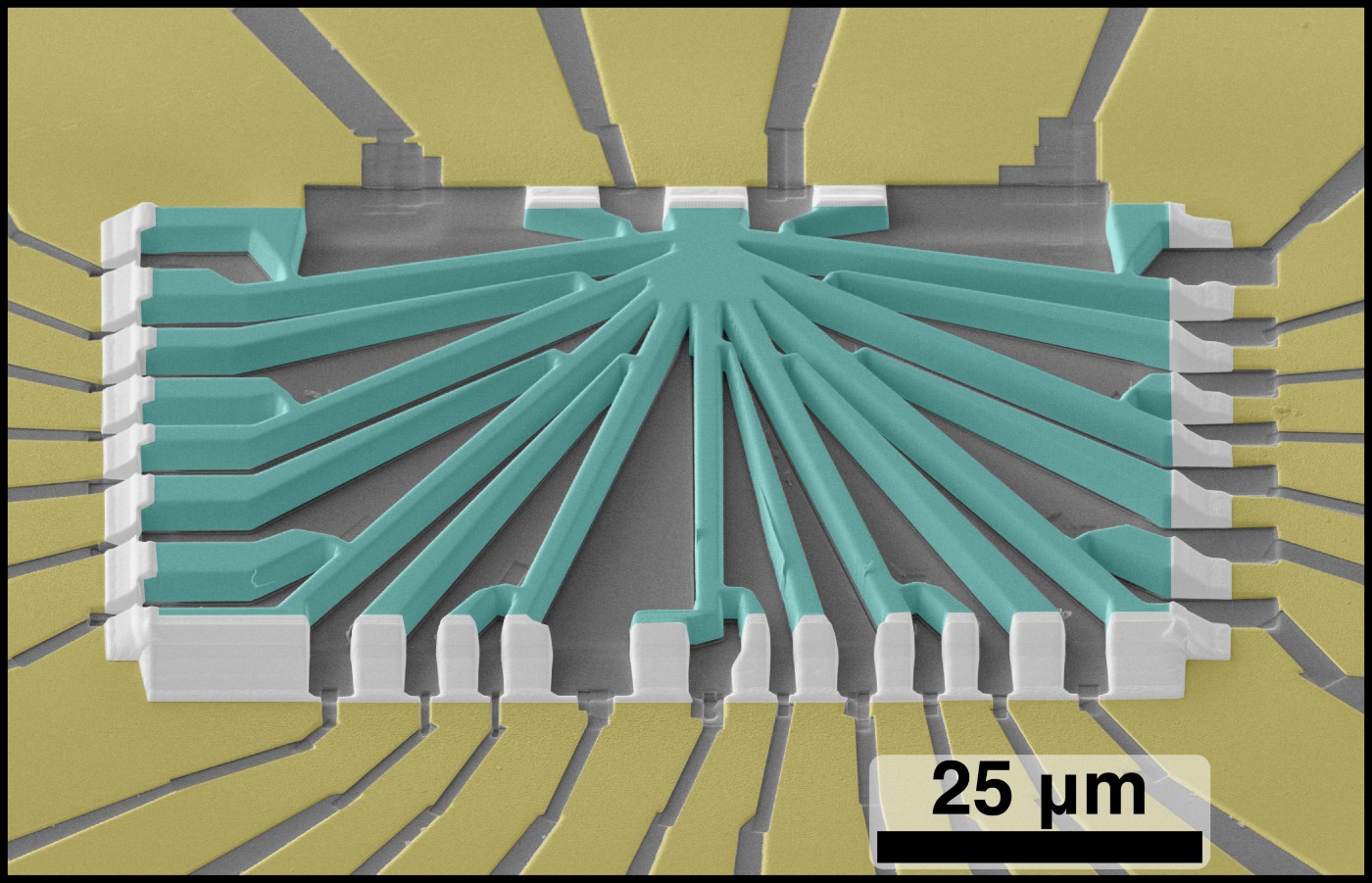
A FIB-fabricated device for angle-resolved transport measurements.
- Measuring the Hall Effect in Hysteretic Materials. Adv. Mater. e23674 (2026).
Materials Discovery in the Age of AI
Computational pipelines can now propose candidate quantum materials by the thousands, and robotic labs promise to make them autonomously. We think this future is worth building, and that it will only work if the machines learn real solid-state chemistry. Our group contributes both the cautionary and the constructive halves of that argument.
On the cautionary side, we re-examined a high-profile claim that an autonomous lab had discovered 43 new compounds and found that none were new, mostly because automated diffraction analysis ignored compositional disorder. Our discovery of an unreported structure type in GdNiSn4, made with classical solid-state chemistry, now serves as a benchmark that every current generative model fails: they only propose variants of structures they have already seen.
On the constructive side, we co-developed Materials Expert-Artificial Intelligence (ME-AI), a machine-learning framework that learns from expert-curated experimental data rather than raw computed databases, and extended it to superconductivity. The model surfaced electron affinity differences between neighboring atoms as a hidden chemical lever and predicted the superconductor PtPb3Bi, which we then synthesized and confirmed. The loop from machine prediction to real crystal is starting to close, and human chemical intuition is the ingredient that makes it trustworthy.
Machines propose, chemists verify: closing the loop from prediction to crystal.
- Challenges in High-Throughput Inorganic Materials Prediction and Autonomous Synthesis. PRX Energy 3, 011002 (2024).
- Materials Expert-Artificial Intelligence for materials discovery. Commun. Mater. 6, 212 (2025).
- Electron affinity difference distributions guide the discovery of the superconductor PtPb3Bi. arXiv:2510.07373 (preprint).
- New Crystal Structures Hide in Plain Sight: A Stress Test for AI-Guided Materials Discovery. arXiv:2603.05613 (preprint).